

08 Sep Direct Cremation: Changing Funerals, Changing Choices By Ryan Guerin
by Ryan Guerin
The way we arrange funerals has never stood still. Today, cremation is such an established part of British funeral traditions that it can be surprising to learn just how controversial the idea once was.
From a controversial idea to the most common choice …
The modern cremation movement in Britain can be traced back to the Victorian era. In 1874, Sir Henry Thompson, surgeon to Queen Victoria, became one of its most prominent advocates. At a time when Britain’s towns and cities were rapidly expanding, Thompson believed cremation offered a practical and sanitary alternative to burial.
That same year, the Cremation Society of England, now the Cremation Society of Great Britain, was founded to promote the practice and establish whether it could legally be carried out.
The Society subsequently acquired land at Woking in Surrey, where a cremation furnace was installed and successfully tested in 1879.
Public and official opposition remained, however, and it would be several more years before cremation became established.
A significant turning point came through the case of Welsh physician Dr William Price. Legal proceedings surrounding his attempt to cremate his deceased infant son helped establish that cremation itself was not unlawful, provided that it did not cause a public nuisance.
On 26 March 1885, the first official cremation took place at Woking. The person cremated was Mrs Jeannette Pickersgill, who was described as a well-known figure in literary and scientific circles.
Just two further cremations took place there during the remainder of that year.
From those very small beginnings, attitudes gradually changed. Further crematoria opened around Britain and the Cremation Act 1902 provided a statutory framework for the regulation of cremation and the establishment of crematoria.
By the end of 1904 there were nine crematoria operating in Great Britain and 4,409 cremations had taken place since Woking opened.
Today the picture could hardly be more different. The Cremation Society’s figures show that more than 527,000 cremations took place across the British Islands in 2025, representing just over 80% of recorded deaths.
In little more than a century, something once regarded as a radical alternative became the way the majority of us choose to say goodbye.
And now the way we use cremation is changing again.
The Rise of Direct Cremation
One of the most significant changes in the funeral profession in recent years has been the growth of Direct Cremation.
A Direct Cremation is a cremation without an attended funeral service at the crematorium. The person who has died is taken into care and the cremation takes place without family or other mourners attending.
The concept itself isn’t entirely new. Funeral directors have long been able to arrange simple or unattended cremations. What has changed dramatically is public awareness and the number of families actively choosing them.
Research from SunLife’s 2026 Cost of Dying Report illustrates just how quickly things have changed.
In 2019, only 3% of funerals in its research were described as direct cremations. By 2020 that had risen to 14%, partly as a consequence of restrictions during the pandemic.
But rather than returning to previous levels afterwards, direct cremation continued to grow.
In 2021 it accounted for 18% of funerals surveyed. In 2023 it reached 20%, and the latest figures for 2025 put it at 21% (more than one in every five funerals).
There are likely to be many reasons behind that change.
Cost is undoubtedly a consideration for some families. The same 2026 research puts the average cost of a direct cremation at £1,628, compared with £4,200 for a traditional attended cremation.
But cost doesn’t tell the whole story.
Attitudes towards funerals are changing too. Some people simply don’t want a traditional funeral. Others would prefer the cremation itself to take place privately and for family and friends to come together separately, perhaps at a favourite venue, at home, or for a celebration of life or memorial at another time.
Interestingly, SunLife found that 86% of people who arranged a direct cremation still held a small gathering, wake, memorial service or a combination of these before or afterwards.
That tells us something important.
Choosing direct cremation doesn’t necessarily mean choosing not to say goodbye.
It can simply mean choosing to do it differently.
Funerals are changing, and so are we
We have cared for generations of local families and remain enormously proud of the traditions of funeral directing.
But respecting tradition doesn’t mean believing every funeral should look the same.
Families today rightly expect more choice in how they say goodbye, and we believe the role of a good funeral director is to adapt to those changing expectations while maintaining the standards of care that should never change.
That thinking is also influencing how we invest in the future of our funeral home.
We have recently received planning approval for a significant development of our premises. While building work has not yet begun, the approved plans include a larger Chapel of Rest and dedicated service space, designed to give families greater flexibility in how they spend time with someone they have lost.
Importantly, we are not designing our future facilities solely around the traditional funeral. We recognise that the way families choose to say goodbye is changing too.
This is particularly relevant to Direct Cremation.
A family may decide that they don’t want an attended service at a crematorium, but that doesn’t necessarily mean they don’t want an opportunity to say goodbye.
They may want to spend some quiet time with their loved one. They may want close family to gather privately. Or they may want a meaningful moment together without the procession, formality or structure of a conventional funeral.
Our planned new facilities will give us even greater scope to accommodate those choices in the future.
Because we believe choosing a simpler cremation should not mean having to give up the opportunity for a meaningful goodbye.
Direct cremation doesn’t have to mean distant care…
The growth of national and online direct cremation providers has undoubtedly helped increase awareness of this type of funeral.
But it has also perhaps created a misconception that direct cremation is something separate from your local funeral director.
It isn’t.
Your local high street funeral director can provide direct cremation too.
And there can be important differences in the way that care is provided and the choices available to families.
When you arrange a direct cremation with us, your loved one is cared for locally by our funeral team. You know who you are speaking to, you can visit our funeral home and there are still personal choices available to you.
With our direct cremation service:
- Your loved one is cared for locally by our funeral team.
- You can provide their own clothes for them to be dressed in.
- You can visit them in our Chapel of Rest during office hours, should you wish to spend time with them.
- We will discuss potential cremation dates with you, allowing us, wherever possible, to avoid dates that may have particular significance for your family.
Not every direct cremation provider operates in the same way, and the choices available can vary considerably.
That is why we encourage families to look beyond the headline price and understand exactly what is, and isn’t, included.
Questions worth asking:
If you are comparing direct cremation providers, there are some simple questions worth asking:
Where will my loved one be cared for?
Who will actually be looking after them?
Can I provide their own clothes?
Can I visit them before the cremation?
Will I know when the cremation is taking place?
Can important family dates be taken into consideration?
How and when will their ashes be returned to me?
The answers may help you decide which provider and which type of direct cremation feels right for your family.
A different funeral, not a lesser one…
Perhaps one of the most important things we can say about direct cremation is that it shouldn’t simply be viewed as a “cheap funeral”.
It is a different choice.
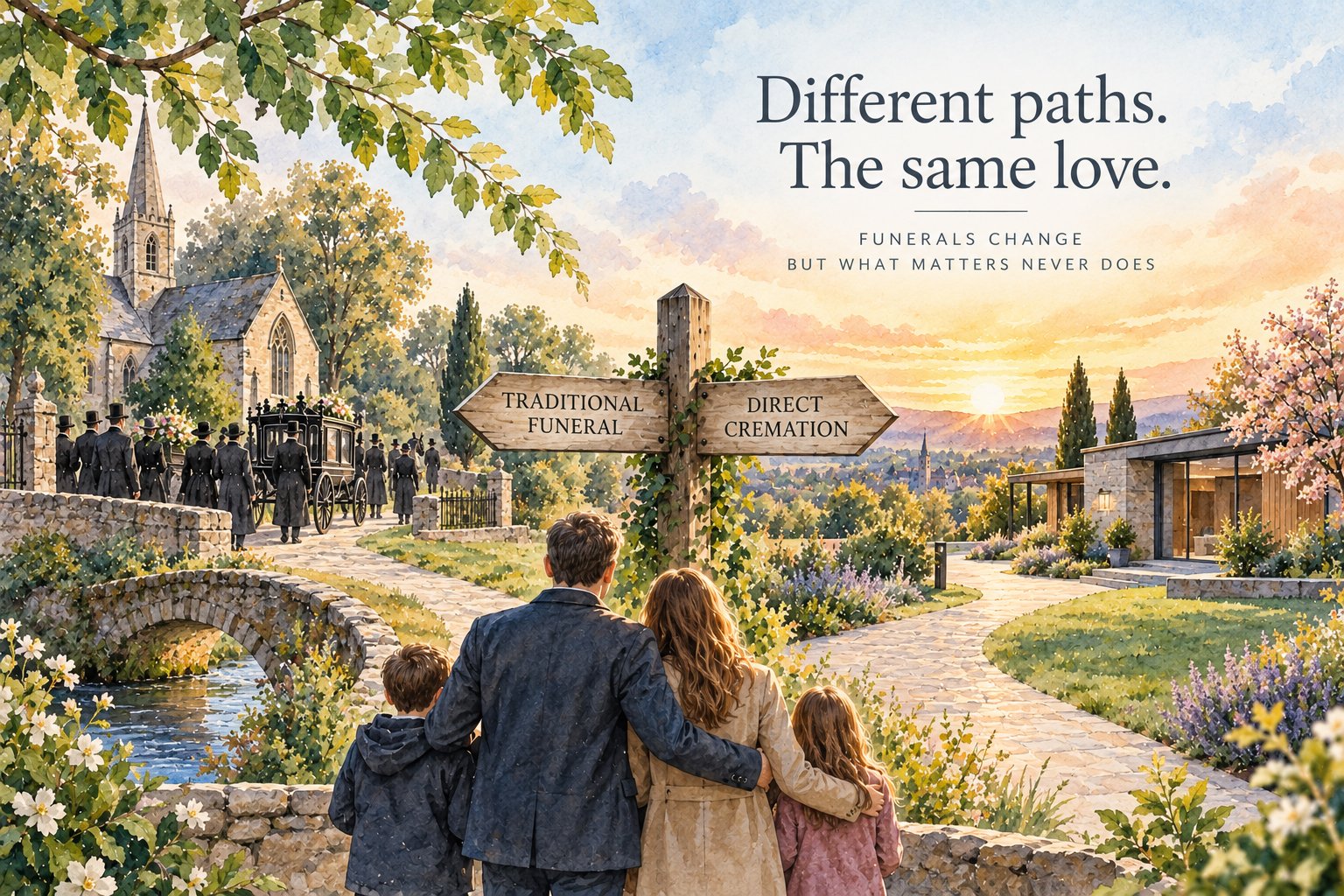
For one family, the right funeral may involve a hearse and procession, followed by a church or crematorium filled with family and friends.
Another may choose direct cremation and hold a celebration of life several weeks later.
Another may want something somewhere between the two, perhaps spending meaningful private time together before an unattended cremation takes place.
All are valid choices.
Our role as funeral directors isn’t to tell a family which of those choices is right. It is to listen, explain the options available and help them make an informed decision.
Local care. More choice.
The funeral profession will continue to change, just as it has throughout its history.
We believe independent funeral directors have an important part to play in that future.
We can embrace simpler and more flexible ways of arranging funerals without losing the things that have always mattered: knowing who is caring for your loved one, having someone local to speak to, being treated as an individual family rather than a reference number, and having the opportunity to say goodbye in the way that feels right for you.
So, if you are considering direct cremation, don’t assume that your only option is a national telephone or online provider.
Speak to your local funeral director too.
Direct cremation may represent one of the biggest changes in modern funeral choices.
But some things shouldn’t change.
Local care, dignity, choice and the opportunity to say goodbye should remain at the heart of what we do.
References:
The Cremation Society of Great Britain – History of Cremation in the United Kingdom and historical statistics.
SunLife – Cost of Dying Report 2026.
Cremation Act 1902 – UK legislation.